Fiji Visit: Working Together for Stronger Parliaments
Published 24 March 2026
How can Commonwealth parliaments be more effective?
That was one of the key points of discussion when when the Speaker from the Parliament of Fiji came to visit us in the UK Parliament.
Hon. Filimone Jitoko, Speaker of the Parliament and Hon. Sakiasi Ditoka, Minister for Foreign Affairs visited us in February this year, together with a cross-party delegation of parliamentarians and officials.
Part of their discussions was sharing how our respective parliaments are working to be stronger, more accountable democratic institutions in the face of modern challenges and constrained resources. Discussions with UK counterparts were particularly focused on effective committee scrutiny, public outreach, women’s representation in parliament and digital transformation.
Effective Committees
Fiji Parliament’s standing committees have powerful statutory tools to summon witnesses and conduct inquiries on topics of public interest. The majority of committee work in Fiji is related to Bills and Annual Reports, so there was interest in exploring how these powers can be exercised for effective policy inquiries and how the UK Parliament embeds good practice and efficient use of resources.
For example, a key challenge for the Fiji Parliament is the availability of specialist staff. While they have professional development programmes ongoing to train existing staff, Fiji faces a ‘brain drain’ as experienced staff often move abroad for new opportunities.
Meanwhile, all UK parliamentary committees have the ability to employ special advisors on a short-term basis for technical subjects, and committees with fewer staff utilise resources created by the Parliament library to avoid duplication of work and strengthen evidence-based scrutiny. They can also use their powers to call expert witnesses in private sessions to provide knowledge and context to the committee.
The impact of AI is an unavoidable question, especially how to navigate the potential benefits versus risks. Gordon Clark, Director of Select Committee Digital Projects discussed how experiments for AI use in Committees are still in their infancy, with great potential to automate routine tasks and free up staff capacity but parliaments must ensure high thresholds for accuracy, confidentiality, and risk. In these experiments, a wide gap between free and paid tools has been noticed, so AI is not a simple or immediate solution to resource constraints.
Women’s Representation
Women currently hold only 5 of Fiji’s 55 parliamentary seats. This is a reduction since 2018 despite efforts by the Fijian Commonwealth Women Parliamentarians group to support women to enter politics. Hon. Premila Kumar highlighted the structural barriers to women’s participation in politics, including financial, social and cultural barriers.
The UK faces many of the same barriers. Baroness Sugg reflected on the disproportionate caring responsibilities that fall on women and how this can make parliamentary life less accessible to women despite efforts to modernise.
There was strong consensus that addressing these barriers requires education, advocacy, and cultural change. One strategy is to reframe the importance of women’s representation as not only an issue of fairness, but as something which leads to better governance and tangible impact on areas from trust in parliaments to healthcare, supported by a growing evidence base.
Outreach and Engagement
Another core focus of the visit was how parliaments can better connect with the public and encourage democratic participation.
UK MP, Christine Jardine, talked about the importance of visibility in the constituency. She said that simply going to the local supermarket or to a local café gives constituents a convenient space to talk about what’s going on in parliament. People may feel parliament is more accessible that way, she said.
In the Fijian context, parliamentarians are elected to a single island-wide constituency via proportional representation. Most members are based in Suva, the capital city, so social media plays a critical role in reaching voters in less accessible regions. However, it was agreed that going the extra mile to attend community events and create space for informal political discussion in person was crucial.
The visit by Fiji highlighted how shared challenges can be addressed through collaboration. The ambition was that UK and Fiji Parliaments should continue to build more effective, inclusive and resilient democratic institutions.
We look forward to continuing our relationship with the Parliament of Fiji and we are grateful to the United Nations Development Programme (UNDP) for supporting this visit.
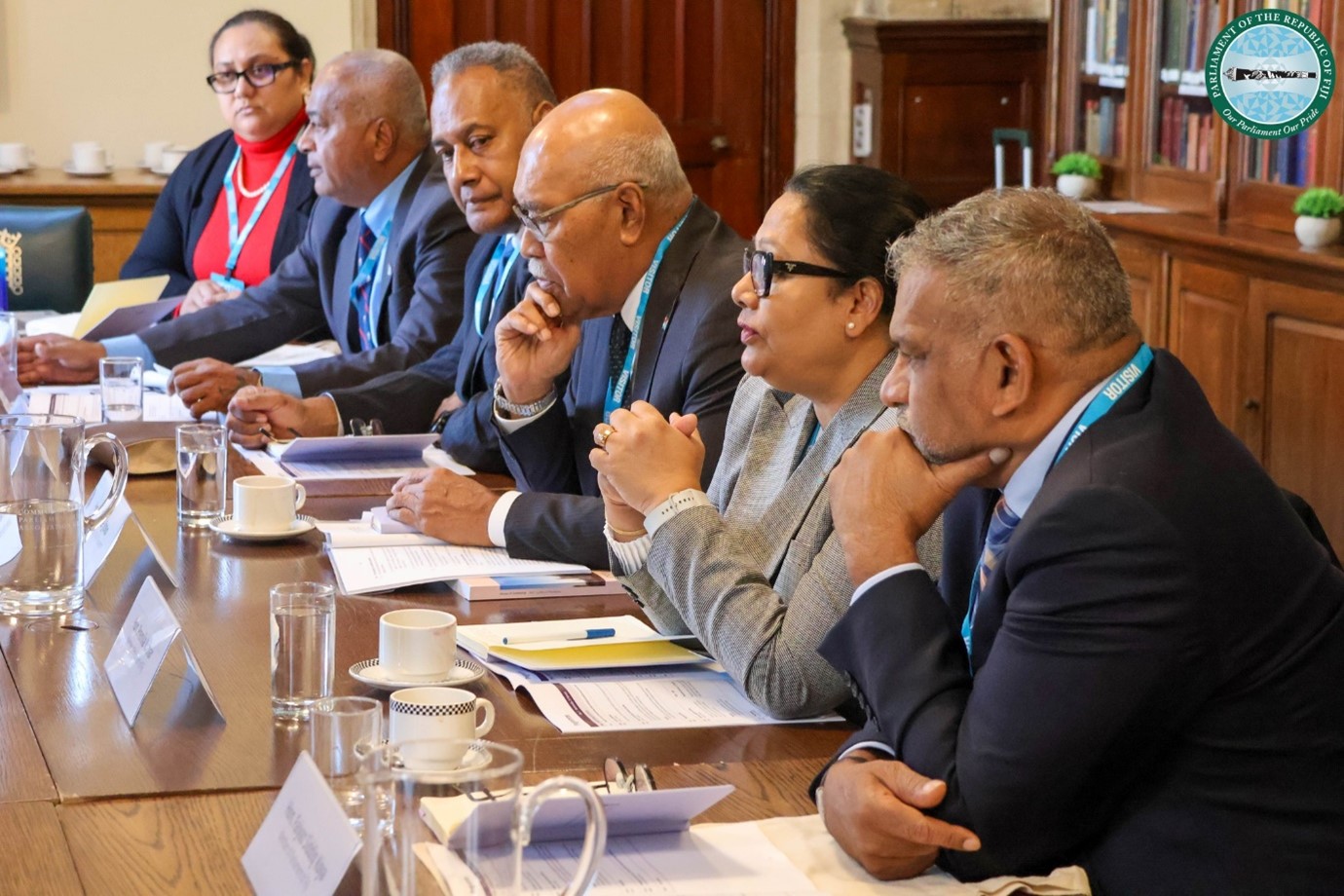
Fiji Delegation to Westminster