Championing Visibility: Reflections from the CPA British Islands and Mediterranean Region LGBT+ Network Forum
Published 09 January 2026
Reflections from the interim Chair, Adam Price MS, and Monitoring and Evaluations Manager, Matthew Hamilton
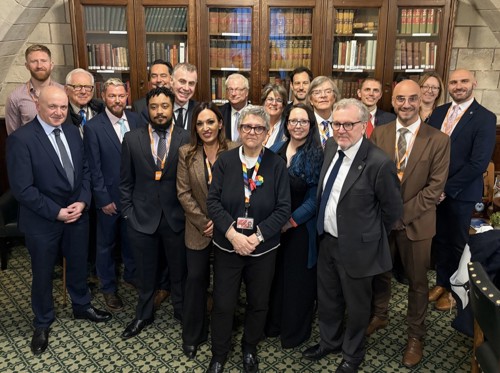
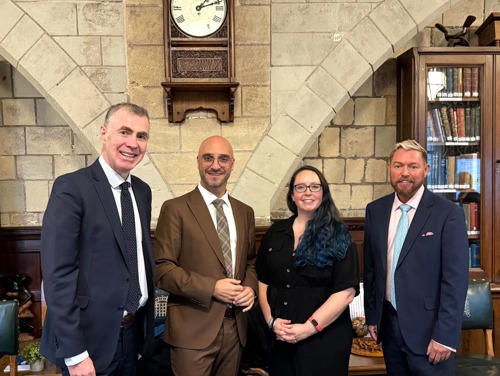
The CPA BIMR LGBT+ Network had its first in-person forum since it was launched in Cardiff last year.
Held in Westminster on 24 November 2025, it brought together parliamentarians from seven jurisdictions as well as LGBT+ advocates and experts in the area of human rights.
Two critical themes were on the agenda:
- the visibility of LGBT+ people in politics across the CPA British Islands and Mediterranean Region, and
- the status of LGBT+ equality across the wider Commonwealth.
Is advocacy still needed?
During the panel which I chaired, I reflected on the progress that has been made over the years. When I first became an elected parliamentarian, I was one of 11 'out' MPs. Now there are 75 'out' LGBT+ parliamentarians in the House of Commons. I asked our panel whether advocacy for LGBT+ participation in politics remains as vital as before. The answer was clear: yes because the work is far from over.
Deputy Louise Doublet emphasised the enduring need for advocacy, highlighting the importance of visibility and recognising intersectionality. She noted that privilege and marginalisation often coexist, and that bi+ identities, representing the largest group within the LGBT+ community, remain widely misunderstood and stigmatised. Her reflections on legislative reform underscored how lived experience can shape inclusive policy, while calling for better data collection and disaggregation to ensure all voices are recognised.
Lord Smith of Finsbury was with us on the panel and spoke candidly about his experiences. He came 'out' 41 years ago, partly because he did not want to be hounded by the UK press. He spoke powerfully about visibility as a form of resilience but confessed that “he was trembling like a leaf” when he first came out publicly:
“The audience gave me a standing ovation. I have never regretted that moment for a single instant. I got letters from people all round the country: congratulations and well done and thank you and ‘what you said has made life easier for me’. That’s another reason why visibility is important because it helps people you don’t even know.”
He said telling your story on your terms gives you armour against homophobia. Lord Smith’s courageous stand was a turning point. Since then, progress on LGBT+ rights has been made across the UK and other parliaments, from the introduction of same-sex marriage legislation to broader equality reforms. He reflected on how visibility not only empowers individuals but also shifts societal attitudes, making intolerance harder to sustain.
Equality across the Commonwealth
Our second panel discussion examined progress and challenges across the wider Commonwealth. According to my own research, the Commonwealth has 205 visibly 'out' parliamentarians, out of 18,000+ parliamentarians. Most of those are in the global north. Meanwhile it is important to recognise that 29 Commonwealth states criminalise LGBT + people.
Stelios Foteinopoulos of The Kaleidoscope Trust, a UK-based charity focused on fighting for the human rights of LGBTI+ people across the Commonwealth and beyond, highlighted stark contrasts. Stelios mentioned that while St Lucia and other Caribbean nations have decriminalised same-sex relations, countries such as Ghana, Uganda and Kenya continue to enforce harsh anti-LGBT+ laws. He warned of the growing influence of anti-rights movements, backed by billions in funding from mainly right wing groups based in the US, and urged renewed political courage to keep equality at the heart of global governance.
Human rights consultant Rico Jacob Chace challenged colonial narratives which frame LGBT+ identities as ‘western imports.’ He cited historical traditions of gender diversity and how India had more progressive legislation on trans issues than many in the west and landmark legal victories achieved through grassroots activism such as crowdfunding in Trinidad and Tobago. His call to action was unequivocal: he believes visibility saves lives and giving platforms to trans and non-binary voices across the Commonwealth is essential.
Finally, UK MP David Mundell reflected on the paradoxical decline in substantive debates on LGBT+ issues in the UK, whilst having one of the most LGBT+ inclusive parliaments. He urged parliamentarians not to be complacent and to reassess priorities and strengthen international collaboration, particularly as external funding streams for LGBT+ organisations face uncertainty.
Where do we go next?
The forum reaffirmed that advocacy is not a relic of the past but a pressing necessity.
Visibility can be a catalyst for change, while solidarity across borders is vital to counter growing threats to equality. It became apparent during our discussions that progress is fragile, and political courage, rooted in introspection and action, is more important than ever.
Parliamentarians in the CPA British Islands and Mediterranean Region as well as across the Commonwealth have a unique opportunity: to champion inclusive policies, defend democratic institutions and amplify the voices of those most at risk.
The CPA BIMR LGBT+ Network will continue to be a platform for dialogue and collaboration, promoting the principle that equality is not just an aspiration but a lived reality for all.
If you would like to know more, or you're a BIMR parliamentarian who's interested in joining, please contact Matthew at: hamiltonm@parliament.uk