Our Commonwealth Youth Parliamentarian
Published 12 August 2026
This blog was written by Melina Otifeh, a DPhil in law candidate at the University of Oxford.
Melina represented the UK at the 13th Commonwealth Youth Parliament in Sydney, Australia.
This article is published in association with Commonwealth Parliamentary Association.
From 27 to 30 July 2026, a select number of young leaders from across the Commonwealth participated in the 13th Commonwealth Youth Parliament (CYP13) in Sydney, Australia, hosted by the Parliament of New South Wales.
I was fortunate to be selected as the UK’s delegate. The purpose of this programme is to simulate a sitting week in Parliament. This year’s CYP focused on the relationship between AI and democracy. Delegates were tasked with debating the ‘Artificial Intelligence and Democratic Integrity Bill 2026.’ Prior to the commencement of the programme, I was assigned as a member of the minority government, the Democratic Progress Party (DPP), in the fictitious state of New Albion.
Day One - Introduction
Day one began with breakfast at the Speaker’s Garden, followed by a tour of the historic New South Wales Parliament and a beautiful Sydney Harbour cruise. These activities enabled me to build genuine connections and strengthen party relationships in a relaxed setting.
I then had my first caucus meeting, where I met our party’s mentor, Hon. Emily Suvaal, MLC (a Member of the New South Wales Legislative Council) and pitched myself for the role of Minister for Technology. Fortunately, I was elected, which meant that I had to prepare a 10-minute speech introducing the Bill the next day. The day concluded with our party discussing potential amendments, and deciding which Members would speak in the First Reading debate the following day.
Day Two - Opening of Parliament
After breakfast and the daily briefing, all CYP delegates attended their respective caucus meetings. During this meeting, we began strategising, discussing our positions and I refined my speech, ensuring it adhered to the 10-minute time limit. After this, I went to the Legislative Council Chamber, where the opening of the ‘New Albion’ Parliament commenced.
This was incredibly exciting because the actual Governor of New South Wales, H.E Hon. Margaret Beazley, AC KC, was in attendance, representing the Sovereign as the Head of State, as would be custom in a real parliamentary opening. The opening ceremony combined constitutional formality, parliamentary tradition and ceremonial procedure.
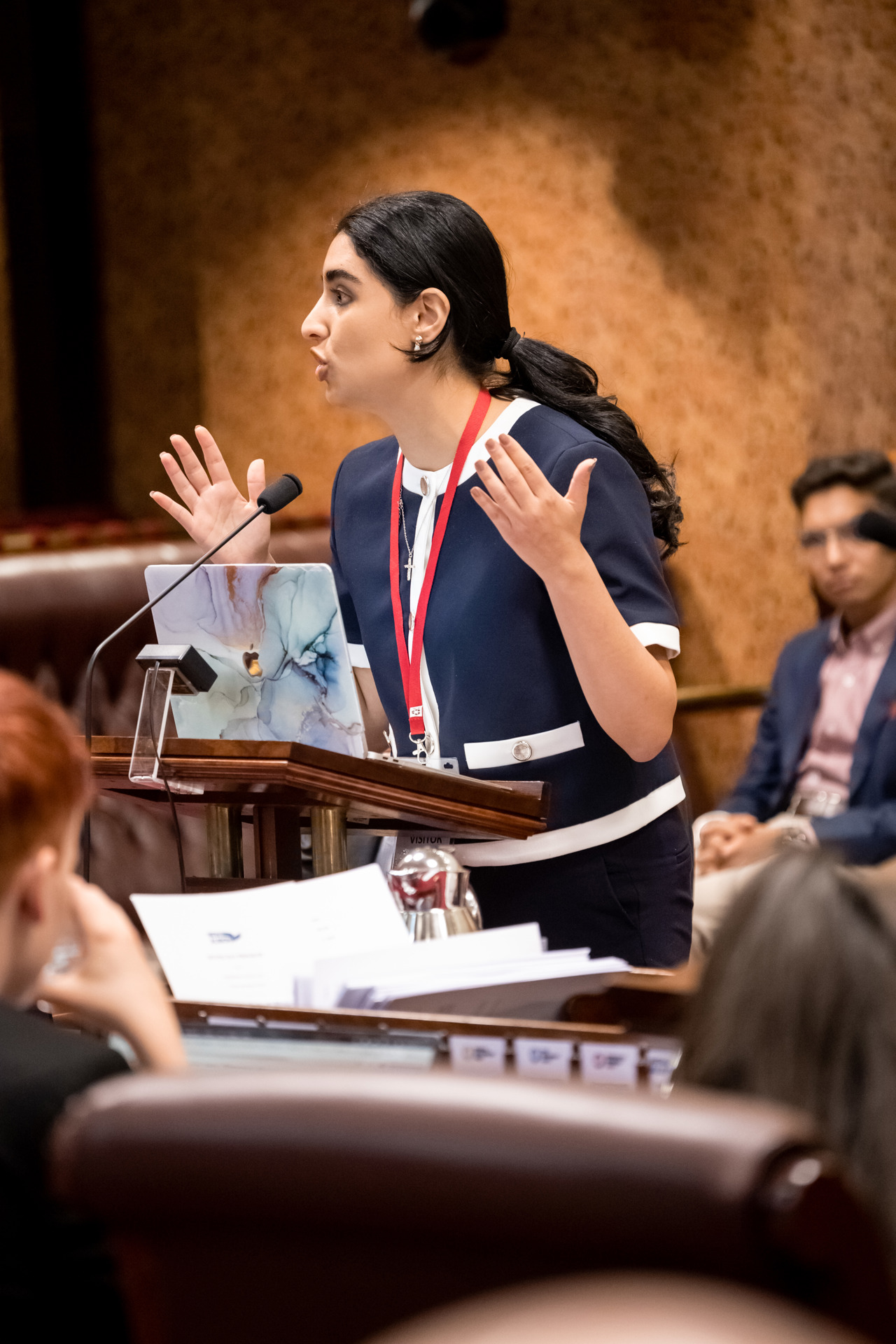
Shortly after the inauguration (signing my name and being confirmed as a Minister), the Second Reading debate commenced. As the Minister for Technology, this was effectively ‘my Bill’, so I was the first speaker. I introduced the Bill, its policy objectives, legislative intent and provided a concise summary of the different sections.
After lunch, I attended a panel discussion on ‘Democracy in the Age of AI’ with Parliamentarians from New South Wales including the Minister for Customer Service and Digital Government, Hon. Jihad Dib, MP; Hon. Jacqui Munro, MP; Hon. Michael Regan, MP; Hon. Kobi Shetty, MP; and Hon. Dr Peter van Onselen, MP. The panellists provided an invaluable insight into the opportunities and risks AI presents for democratic institutions.
I then attended the third caucus meeting where I began preparing for Question Time the next day, including printing and reading our media reports. We then went back to the Chamber for the first adjournment debate, where delegates spoke about a topic of their choice, unrelated to the programme, for three minutes.
The evening concluded with a memorable reception at Government House in Sydney’s botanical gardens. Delegates replicated the ‘address and reply’ procedure ordinarily expected of Members of Parliament, and the Governor formally received each of us. I subsequently networked the night away, accompanied by a melodious military band, a selection of canapés and champagne.
Day Three - Question Time
Day three started with a caucus meeting, where I met with Hon. Rose Jackson, MLC. Rose is the New South Wales Minister for Housing, Homelessness, Water, Mental Health, Youth and the North Coast. Rose is renowned for her intrepid approach to Question Time. After speaking about her respective roles, Rose offered important advice on how to succeed in Question Time. As the government, we anticipated scrutiny of our Ministers, Premier and of course, the Bill itself. I was, admittedly, apprehensive about Question Time as I could be asked not just about the two media reports assigned to me, but about anything pertaining to the contents of the Bill. However, Rose motivated and encouraged us to stand up for (and defend) our Bill.
During Question Time, I was asked three questions. The first two were fairly easy to answer as I had negotiated with the opposing Members prior, so I felt prepared. My fellow DPP Members also filled the chamber with ‘hear hears’ so I felt encouraged to keep going. The last question, however, completely caught me off guard and was quite complex (it transpired that this was a tactic deployed by the opposing party Member!). There was heckling and ‘shames’ thrown by the opposing Members, but it was all in jest and both enjoyable and funny. I decided to take this question on Notice, meaning I had to submit the answer by 8am the following day.
After lunch, all delegates participated in a cultural immersion experience, including drawing Aboriginal art on a boomerang and making bracelets. It was lovely to unwind by engaging in something creative, and it was fascinating to learn more about the First Nations cultures in Australia and the connection to Country.
Afterwards, I attended the fifth Caucus meeting where I worked on my reply speech for another whole-house sitting in the afternoon. I then returned to the Chamber where the Premier of New South Wales, Hon. Chris Minns, MP, delivered a keynote address to the CYP delegates. He shared his insights on leadership, public service and the important role young people play in shaping the future. Shortly after, the debate on the Bill continued, and I gave my reply speech summarising the position of the government and our response to the opposing parties’ proposed amendments.
The evening concluded with a warm reception at the British Consulate. Here, I met the Deputy British Consul, Edward Kitt and gained insight into his role. Throughout the evening, I negotiated further with opposing parties to reach consensus on amendments. My aim was, ultimately, for the Bill to pass. Similarly to the question I took on Notice, each party’s amendments had to be submitted by 8am the next day.
Day Four – Amendments
I woke up early to submit my answer to the question I took on notice, before helping my fellow party Members to finalise their amendments. During breakfast at the hotel, I was informed that there would be a vote of ‘no confidence’ against the Premier of ‘New Albion’ by a few disgruntled Members of the DPP! This led to a very interesting and theatrical final caucus meeting. The vote of ‘no confidence’ failed, and we continued preparing our responses to proposed amendments from opposing parties and discussed potential pushbacks to our own amendments. Prior to the caucus meeting, there was a daily briefing with an address by Hon. Penny Sharpe, MLC, Leader of the Government in the New South Wales Legislative Council.
Thereafter, the Committee of the Whole and Third Reading of the Bill commenced. During the former, I proposed, debated and voted on amendments. This involved negotiating across party lines and thinking on my feet to refine proposals. All three of the amendments I proposed were accepted. Thankfully, following days of preparation, negotiation and debate, the Artificial Intelligence and Democratic Integrity Bill 2026 passed.
The final Adjournment Debate was held, followed by heartfelt felicitation speeches in which party leaders reflected on lessons learned and the hard work of each delegate.
The programme concluded with an official dinner, accompanied by a beautiful string quartet. I had the privilege of hearing an address from the Lieutenant-Governor and Chief Justice of New South Wales, Hon. Andrew Bell AC, whose remarks underscored the importance of leadership and the enduring strength of the Commonwealth.
Overall, the programme was demanding, yet incredibly rewarding, insightful and, perhaps most importantly, fun. I left with a renewed sense of confidence, a deeper understanding of parliamentary procedure and practice, and newfound friendships. I will forever cherish this experience, the people that I met and the encouragement I received. I leave with a deeper belief in the value of democracy, service and the difference each of us can make in our own communities.