AI and the Future of Work: What Does it Mean for Your Constituency?
Published 20 July 2026
As artificial intelligence develops rapidly, understanding its impact on the UK labour market becomes a priority. That’s because 70% of the UK workforce have AI exposed roles.
In June, CPA UK delivered a briefing on AI technologies and their impact on the UK labour market. Hearing from three experts, the briefing covered topics on ‘AI exposure’, opportunities for younger people in a shifting labour market, and how organisations might adopt technological approaches to workflows that empower and work alongside people, rather than displace them.
AI Exposure: 70% of the UK labour market have ‘AI exposed’ roles
What does it mean to have a job which is ‘AI exposed’? Dr. Teeselink, Lecturer from King’s College London, explained that a role, which is made up of a list of tasks, is exposed to AI depending on how many of those tasks can be augmented or automated by AI tools.
For example, a paralegal has many tasks including drafting case summaries. These tasks are highly exposed to AI tools, whereas human centred tasks, such as holding in-person interviews, face little or no AI exposure.
To demonstrate how AI exposure varies across the UK, Dr. Teeselink shared a map of AI exposure across UK constituencies.
AI exposure in a role does not always mean that tasks become fully automated. It is not inevitable. These tasks could be augmented using AI tools, allowing focus on more challenging and higher-value parts of the role. It is estimated that 70% of UK roles have some degree of AI exposure.
Young people in a shifting labour market
Junior or entry level roles are most exposed to AI tools. Younger employees typically have roles which are described as routine and administrative. Their tasks can be automated by an AI tool.
Because of this, organisations may tend to advertise less junior or entry level roles, opting for more middle level roles. Peter Cheese, Chief Executive of CIPD, described how organisational structures are moving away from a traditional triangular shape, with many junior level roles at the base, towards a diamond shaped model, where the majority of roles are mid-level. This diamond shape leaves fewer traditional entry points.
However, Mr Cheese explained that the rate of application of AI tools across organisations is inconsistent. He said different organisations will see longer term implications of AI technologies at different paces. For instance, developments in robotics will impact roles in manual labour and manufacturing at a vastly different rate from organisations that may roll out systems of agentic AI (where AI technologies can deliver multi-step tasks with reduced human interaction), organising tasks or workflows using AI augmentation or automation.
Human-centred technology in the workplace
Popular narratives around AI often focus on the threat of displacement of jobs. However, AI technologies vary in their capabilities, and employees who end up working alongside such technologies may find their roles change rather than disappear.
Oliver Nash, Associate Director of the Institute for the Future of Work, shared research conducted by the Pissarides Review into the Future of Work and Wellbeing. A key takeaway from the research underscored that there can be both positive and negative effects of AI technology within the same role.
“Within this debate, we often talk about winners and losers. Some will do really well and others will be negatively impacted. In reality, all of us, in different ways, will experience some good things, and other things that are a lot more challenging.”
Mr Nash’s presentation also emphasised the importance of human-centric skills such as critical thinking, leadership, problem solving, and communication, He said these are crucial alongside AI technologies and will be increasingly important to organisations.
The briefing is aimed at parliamentarians and parliamentary staff. To receive a link to the briefing, please email amines@parliament.uk

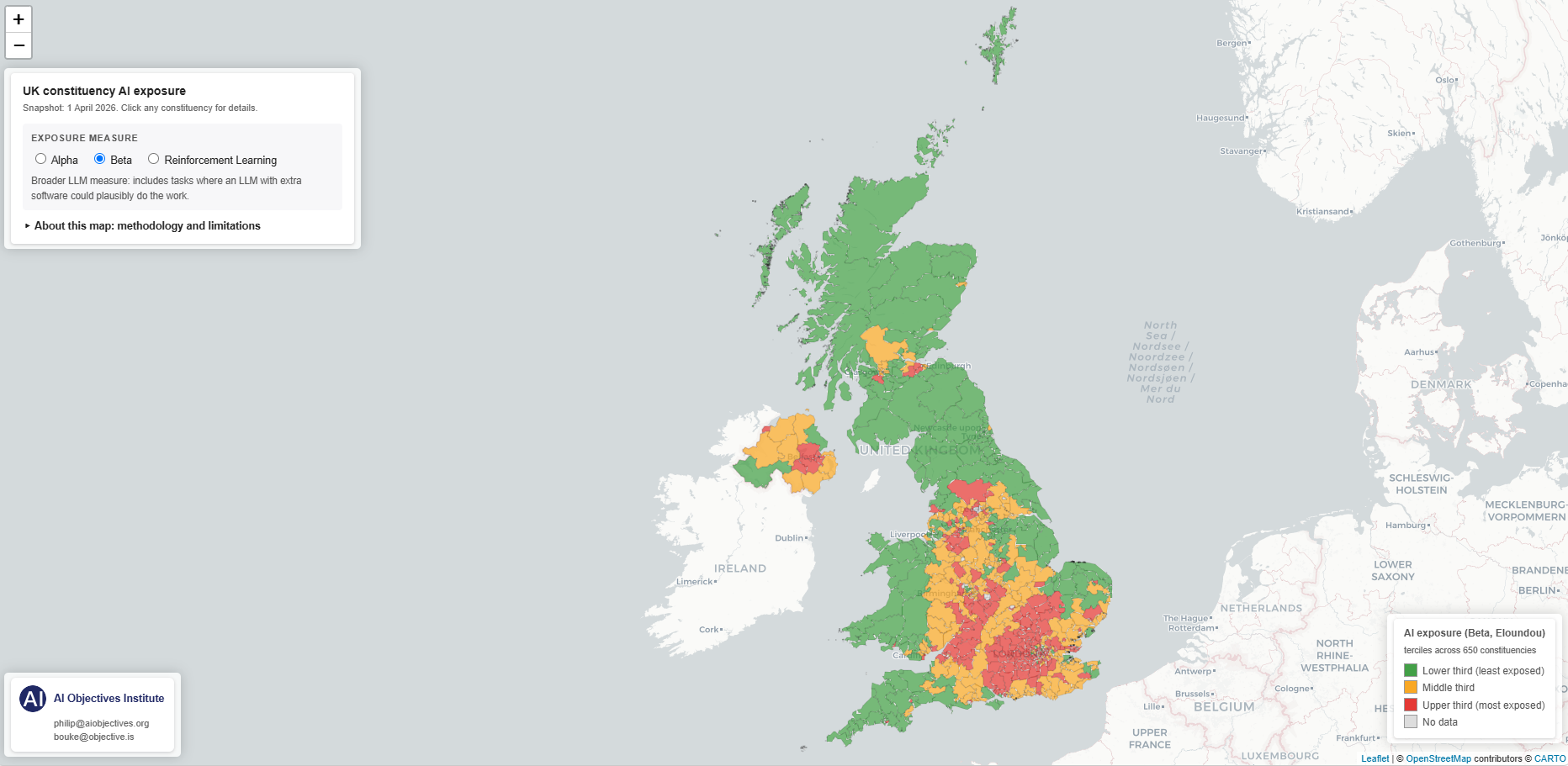
Screen capture of the AI exposure map across UK constituencies, July 2026